MomentProduct Design LeadPayments · 0→1South Africa
A unified billingproduct for Africa
Replacing manual payment chasing with a self-serve billing & payment flow —
dynamic enough to adapt to any merchant, without custom builds.
Role
Design Lead — strategy, research, IA, UI, design system
Team
Product, Engineering, Business, Experience Design
Timeline
2024 — phased delivery
Markets
South Africa, expanding continent-wide
Interactive prototype — tap through the live flow
At a glance
Product Unified Billing
A self-serve billing & payment product for African markets that replaces manual payment
chasing — dynamic enough to adapt to any merchant without custom builds.
Details
Web product · responsive flow
surface
Design Lead — strategy, research, IA, UI
role
Product · Engineering · Business · XD
team
0→1 Product Strategy · UX/UI · Design System
scope
Problem Chasing payments
Without a self-serve billing page, merchants chased outstanding payments by phone, SMS and
WhatsApp, while customers paid into a void and then had to prove they'd paid.
Solution One dynamic flow
I led the 0→1 design of a single, themeable flow — bill → checkout → payment → receipt — that
scales across merchants and payment methods with no bespoke builds.
Result Scaled across brands
One system replacing per-merchant custom builds, unifying 4+ local payment methods
and fully themeable per brand — cards, Capitec Pay, transfers and vouchers.
1
Scalable Billing System
Replaced per-merchant custom builds
4+
Payment Methods Unified
Cards, Capitec Pay, transfers, vouchers
100%
Themeable Per Brand
Configurable for any merchant use-case
01 / Discovery
Finding the problem
I ran on-site field research across African markets to understand how
merchants actually get paid — not how we assumed they did. The pattern was everywhere and
invisible in our analytics: getting paid was a human process, not a product one.
South African merchants rarely had a self-serve billing page. To recover outstanding
payments they leaned on manual recovery — call-centre follow-ups, SMS nudges
and WhatsApp/email reminders, often sending bank details or a reference and asking the
customer to confirm once paid.
Money owed was chased one conversation at a time — expensive and slow.
Customers paid into a void, then had to prove they'd paid.
No shared source of truth between merchant and customer.
02 / Problem
The problem statement
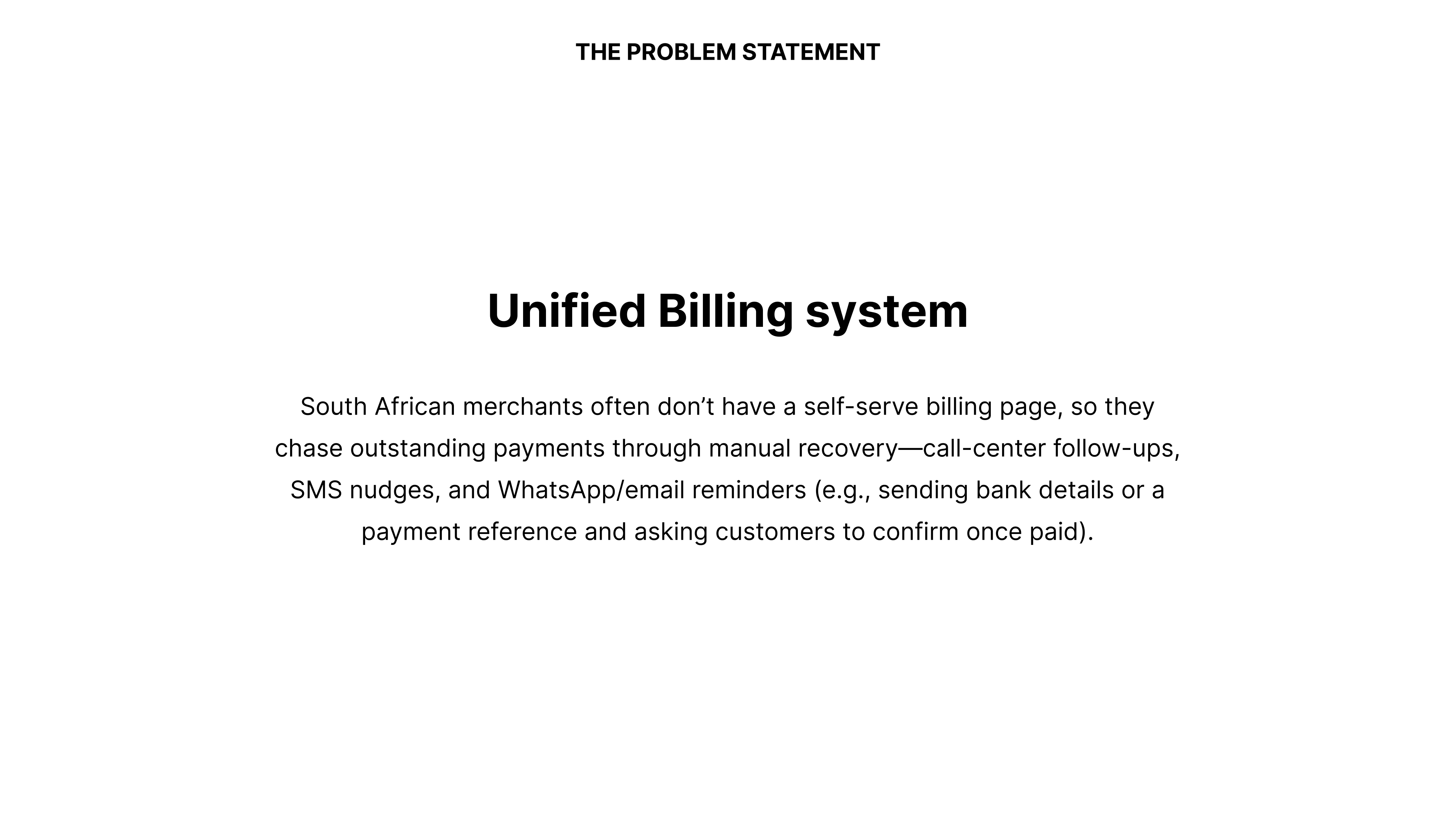
Without a self-serve billing page, merchants chased outstanding payments manually while
customers paid with no confidence the payment landed. As Moment, we needed a
scalable, self-serve billing product that adapts seamlessly across diverse merchant use
cases — without custom builds — yet stays dynamic and scalable, meeting global
standards while remaining intuitive for local users.
Identifying quick wins
Replace manual recovery with a self-serve billing & payment flow.
Merchants need to "get paid without chasing."
Customers need to "pay safely, with confidence."
One product that scales across merchants and payment methods, not bespoke builds.
Framing the problem: manual recovery is the default for South African merchants.
03 / Research
Research & jobs
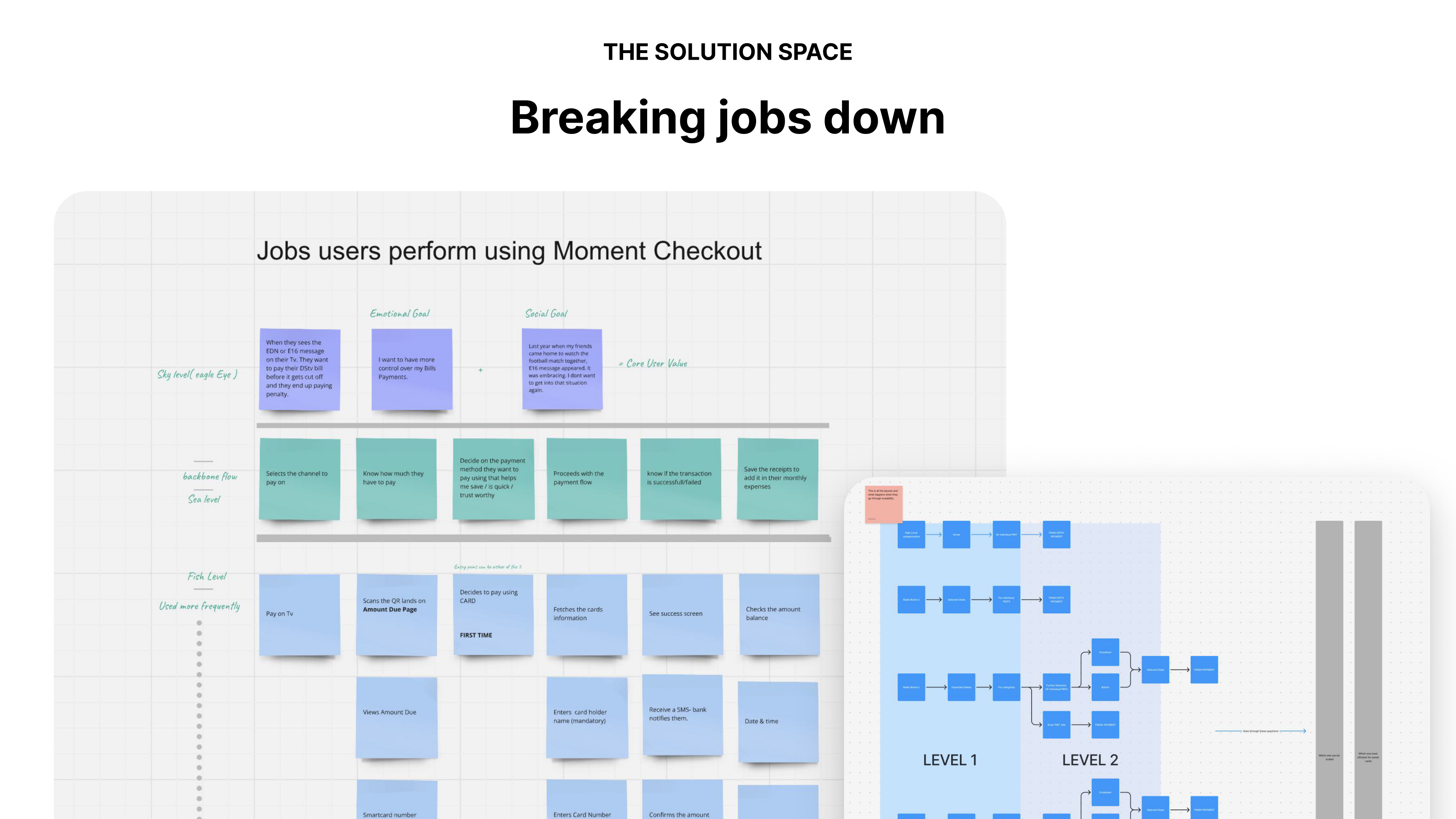
I mapped the jobs people perform in a Moment checkout across three altitudes — the
sky-level emotional & social goals, the backbone of the core flow,
and the fish-level tasks users repeat most. This kept the team anchored on user
value, not screens.
Emotional goal: "I want more control over my bill payments."
Social goal: contextual moments — e.g. paying the DStv bill before the match.
Core value: decide a payment method that feels quick & trustworthy, then know the transaction succeeded.
Breaking jobs down across sky / backbone / fish levels.
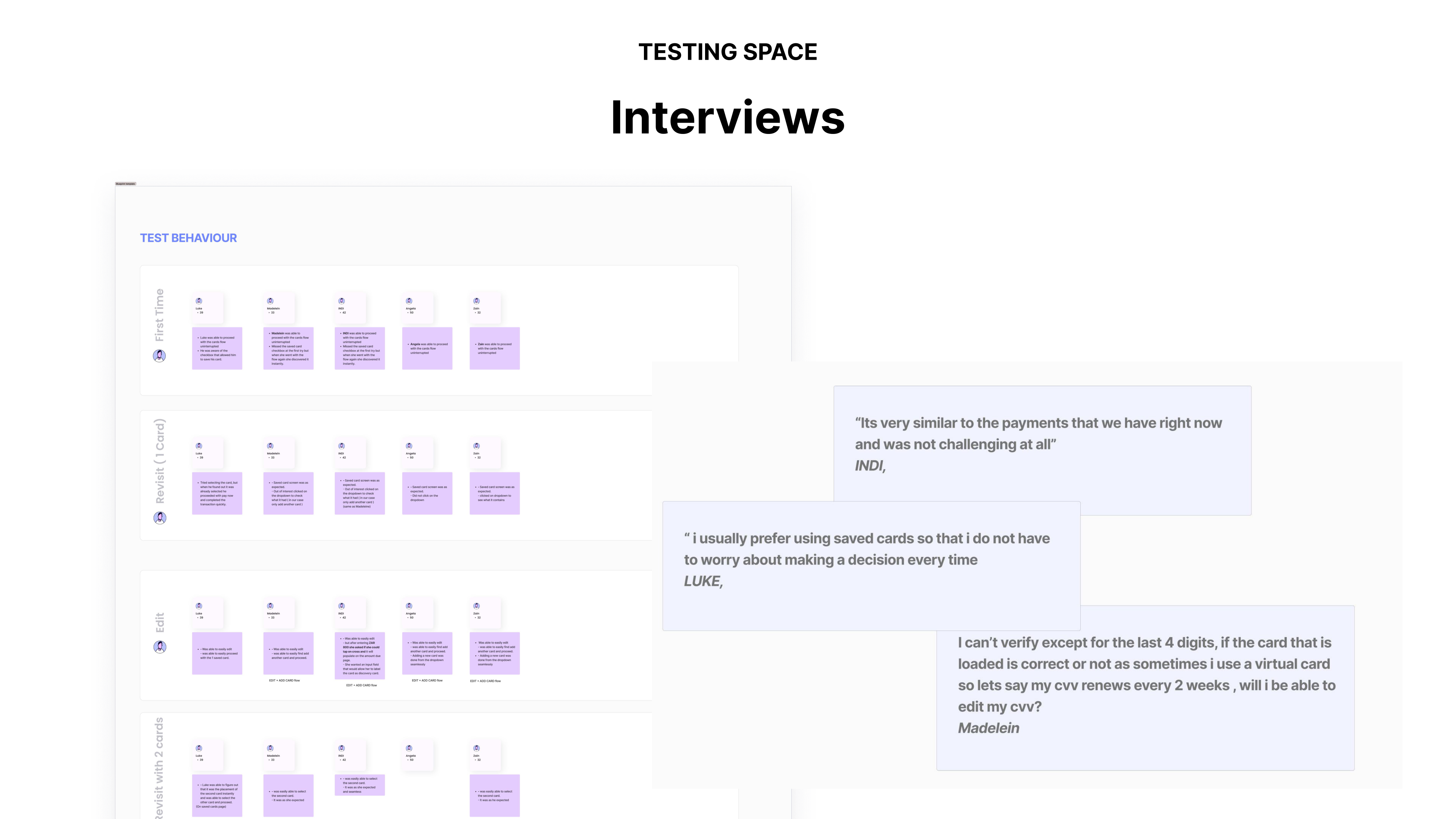
Then I pressure-tested the flow with real users — first-time and repeat — to surface where
trust broke and which decisions mattered most.
Testing behaviour with first-time and returning users; verbatims drove decisions.
04 / Method
Method & architecture
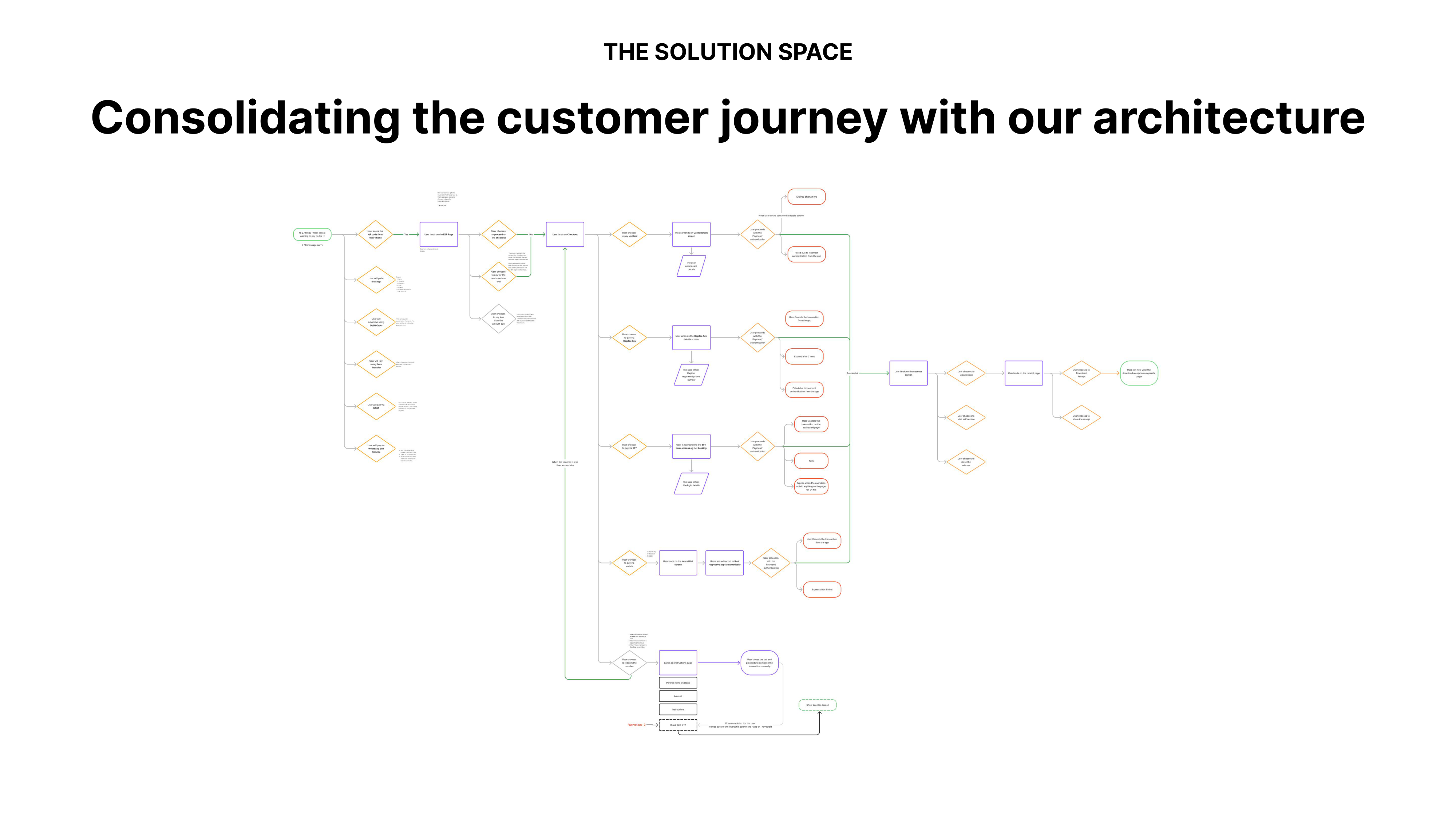
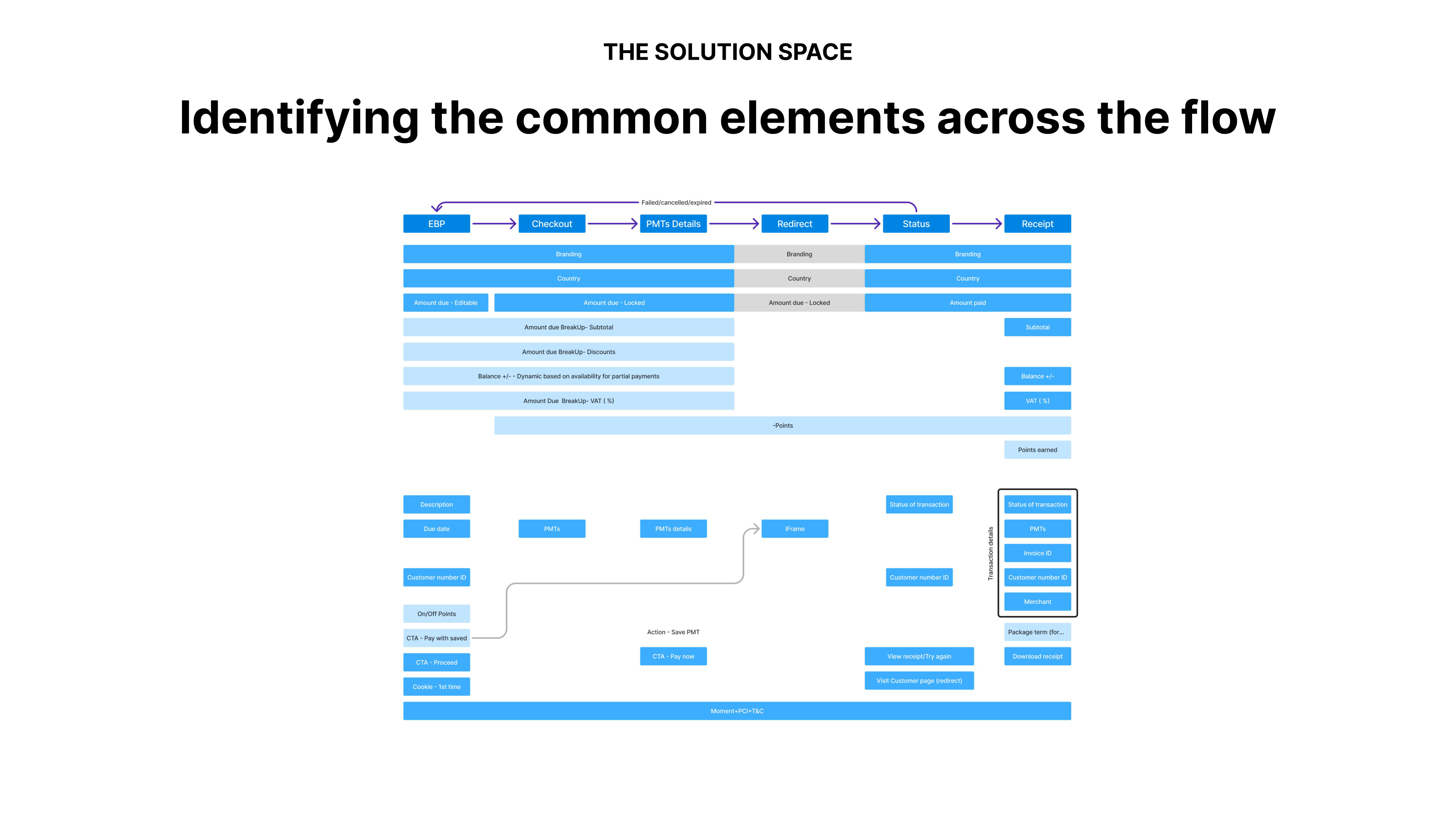
I consolidated the entire customer journey into a single architecture, then reduced it to a
repeatable spine: EBP → Checkout → Payment details → Redirect → Status → Receipt,
with failed/cancelled/expired routes folding back in.
The full journey, consolidated into one architecture.
From there I identified the common elements across every screen — branding,
country, amount states, breakups, points, transaction details — so a single component set could
power every merchant and every method.
Mapping shared elements → the foundation for a scalable component system.
05 / Communication
System & collaboration
To make "no custom builds" real, I built a scalable design system from scratch
that maps directly to the common-element model — so product, engineering and business could
compose any merchant experience from the same parts. I also integrated AI into the design
workflow to move from spec to variations faster.
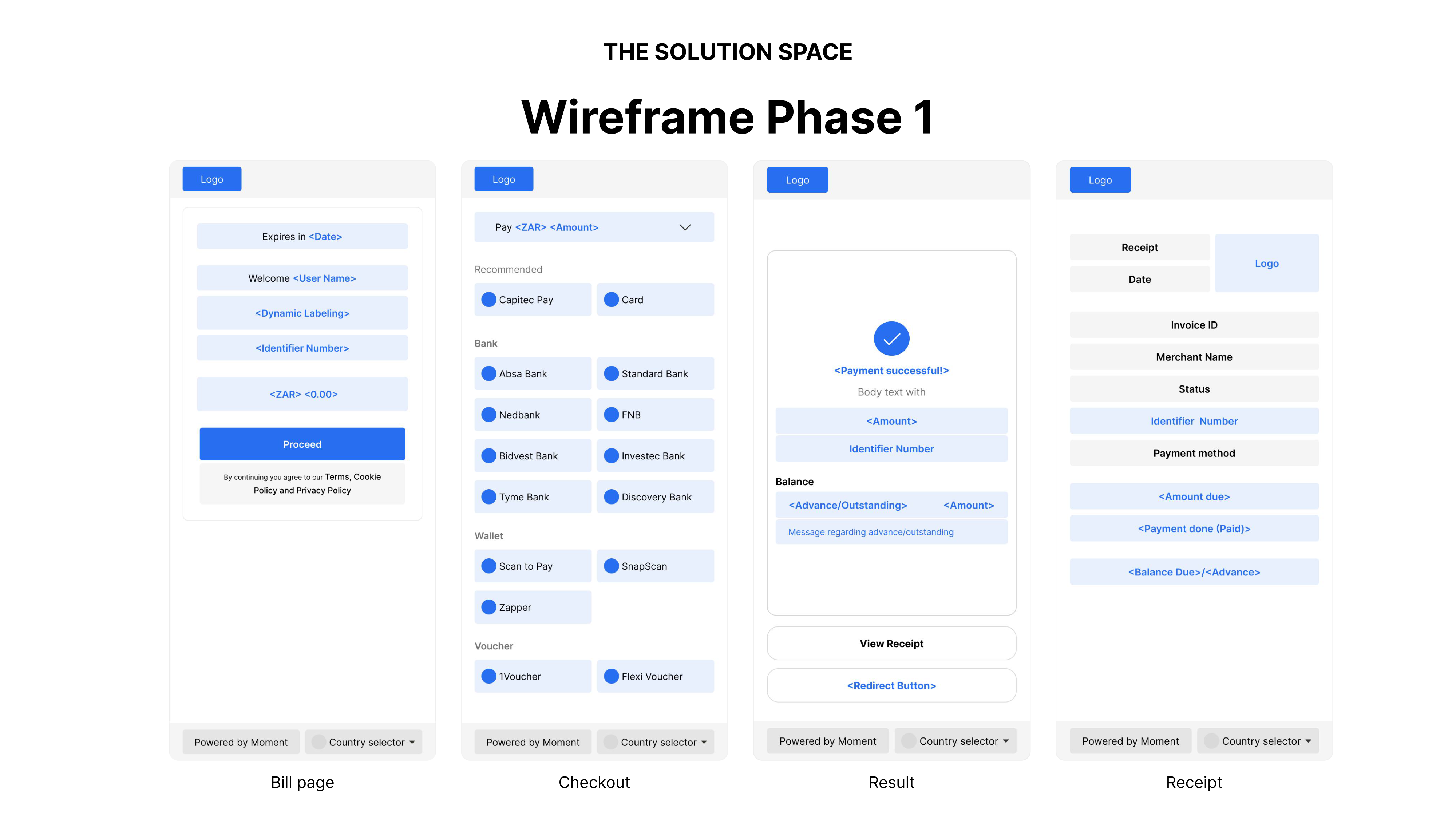
Wireframes acted as a shared contract between design, eng and business.
Components encoded dynamic states (locked vs editable amounts, partial payments, VAT, discounts).
Drove cross-functional delivery so the same system shipped across markets.
Phase-1 wireframes: bill page → checkout → result → receipt.
06 / Iteration
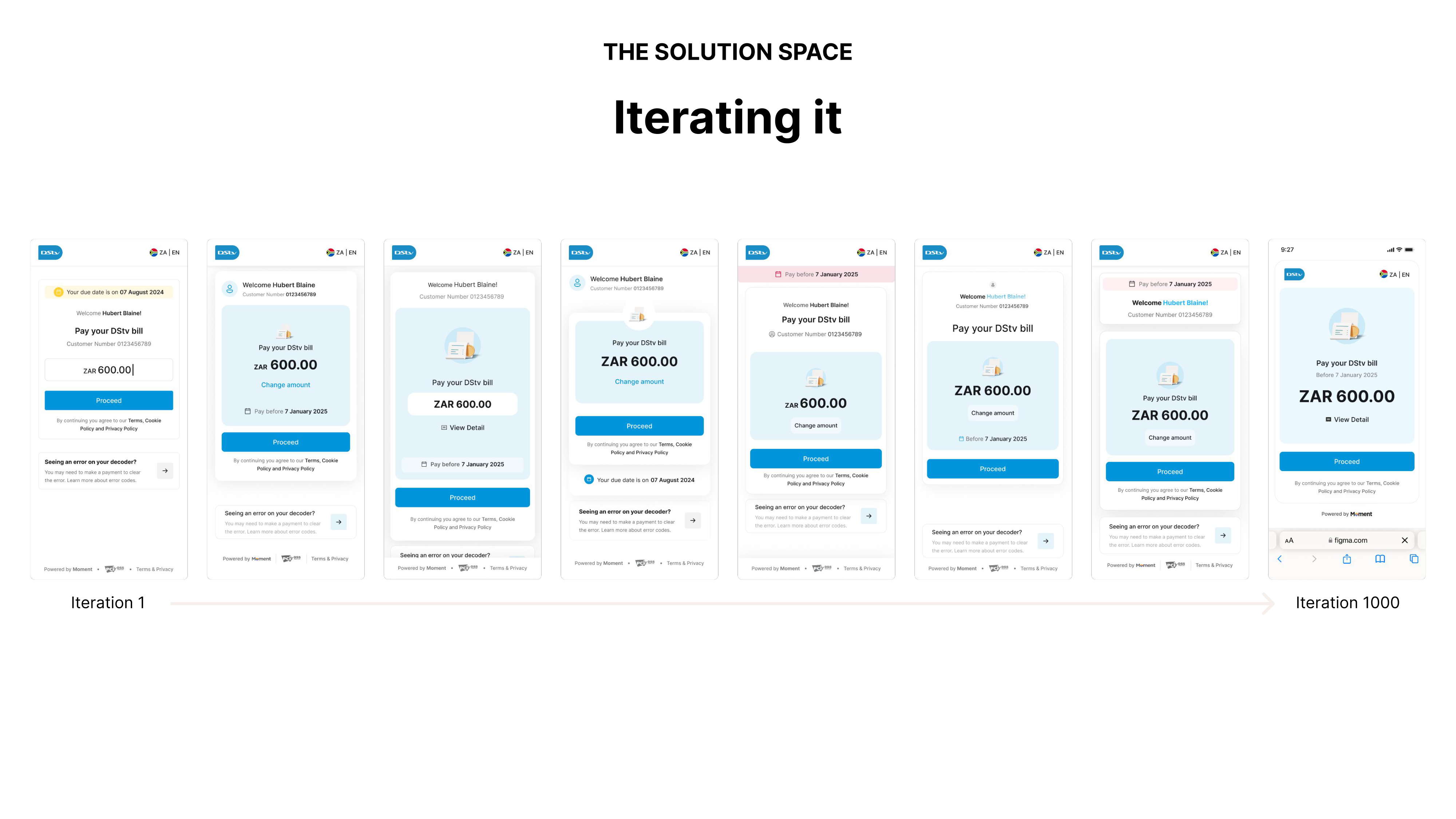
Iteration, 1 → 1000
The bill page went through dozens of iterations — tuning hierarchy, the amount field, due-date
framing, error guidance and trust cues until first-time users could pay without hesitation.
From the first rough cut to the shipped bill page.
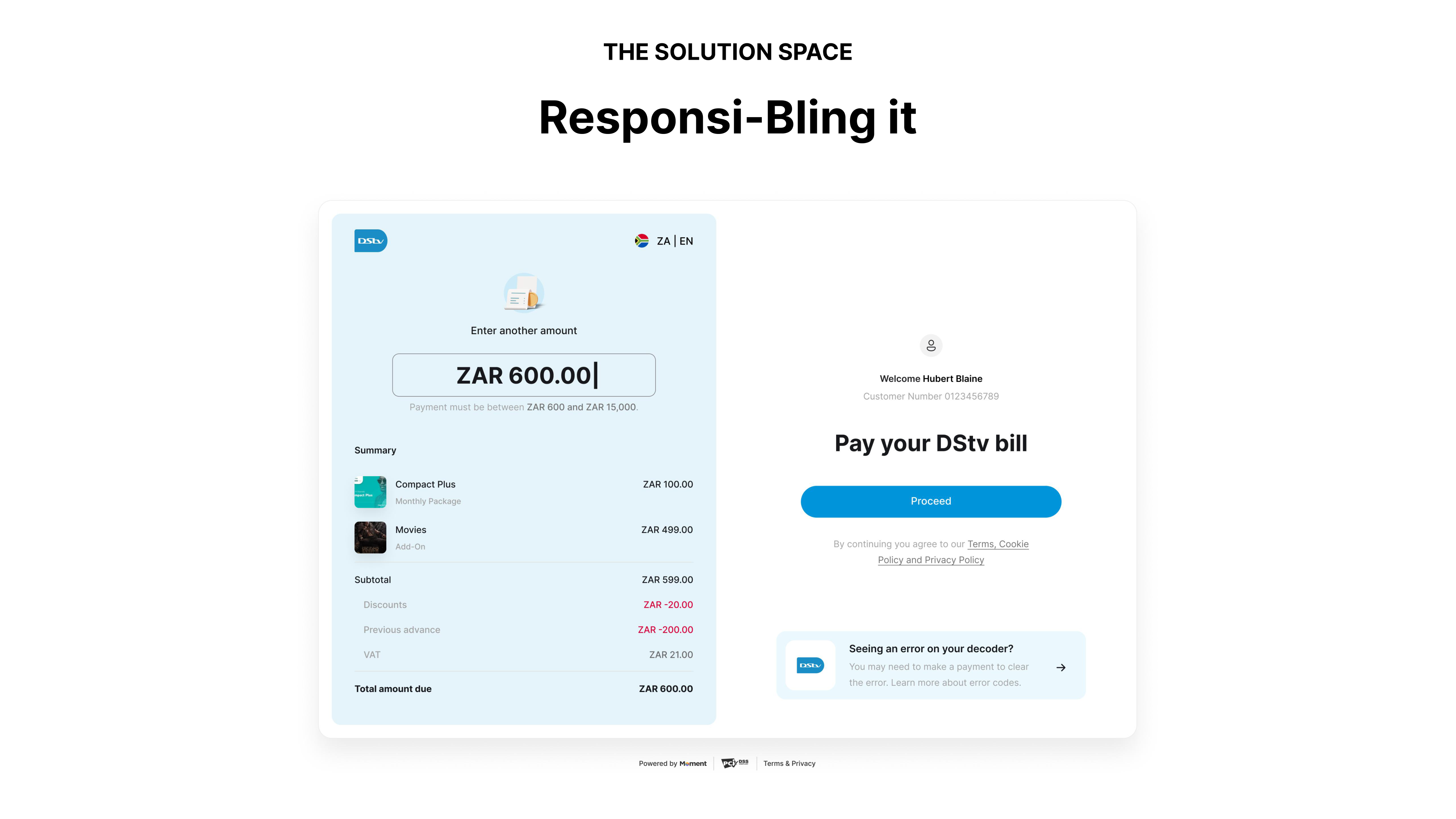
I made it responsive across breakpoints, with a desktop summary that exposes the
full amount breakup — subtotal, discounts, previous advance and VAT — without overwhelming
smaller screens.
"Responsi-bling it" — the responsive layout with itemised breakup.
07 / Final
Final & prototype
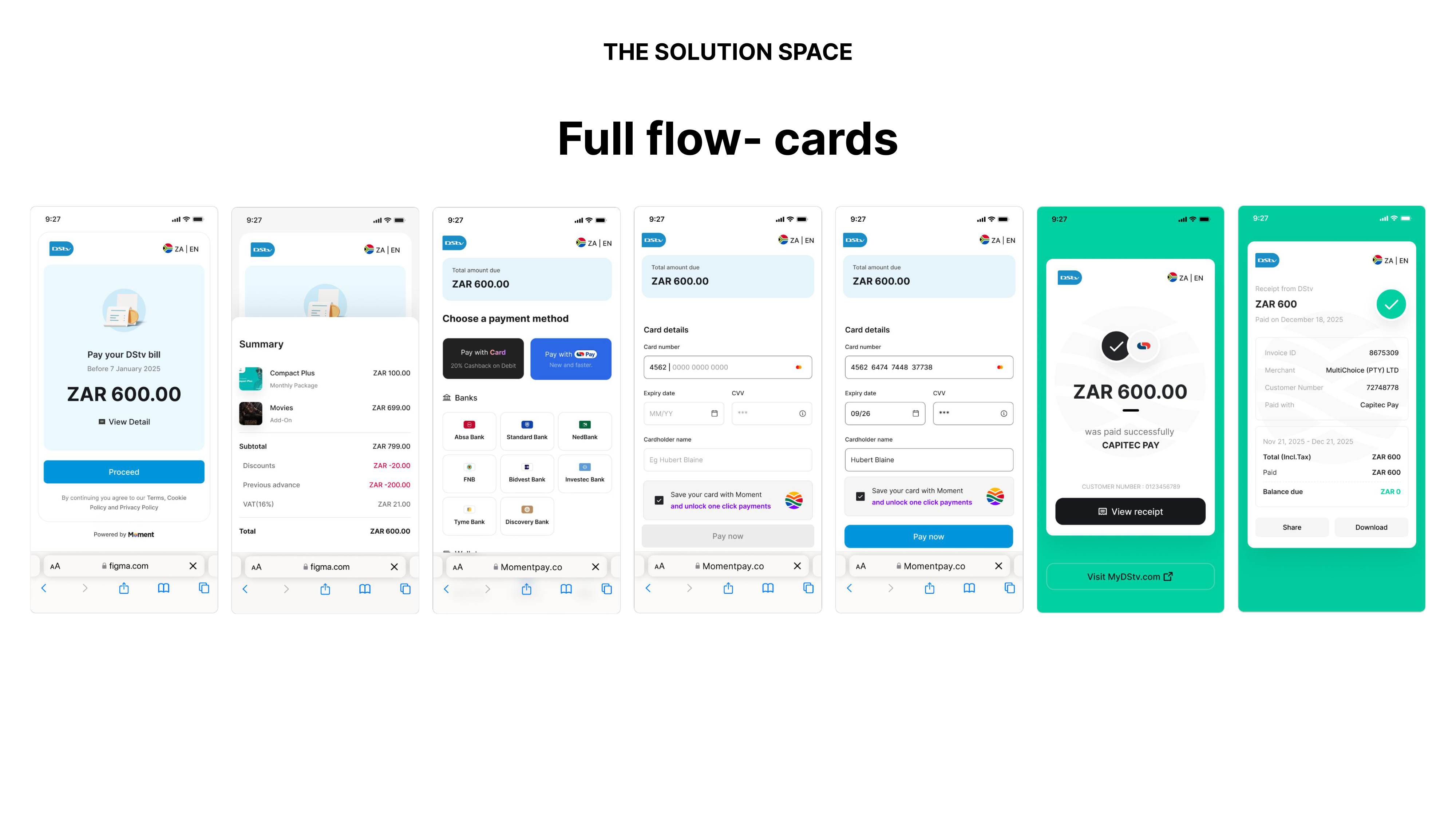
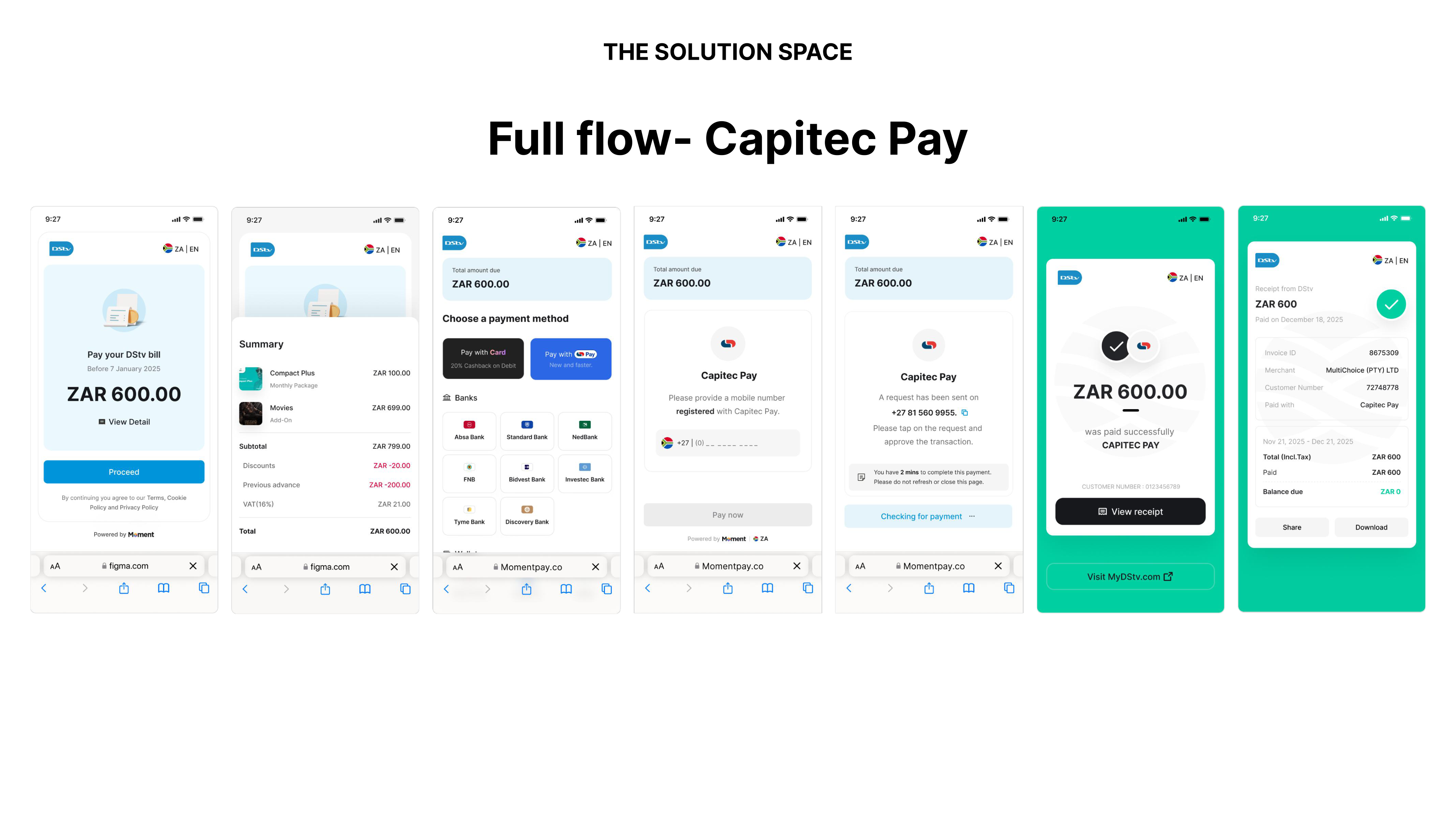
The shipped product is a complete, self-serve flow that handles every local method — cards,
Capitec Pay, bank transfers and vouchers — through to a shareable receipt.
End-to-end card flow: bill → method → details → success → receipt.Capitec Pay — a localized, request-to-approve method.
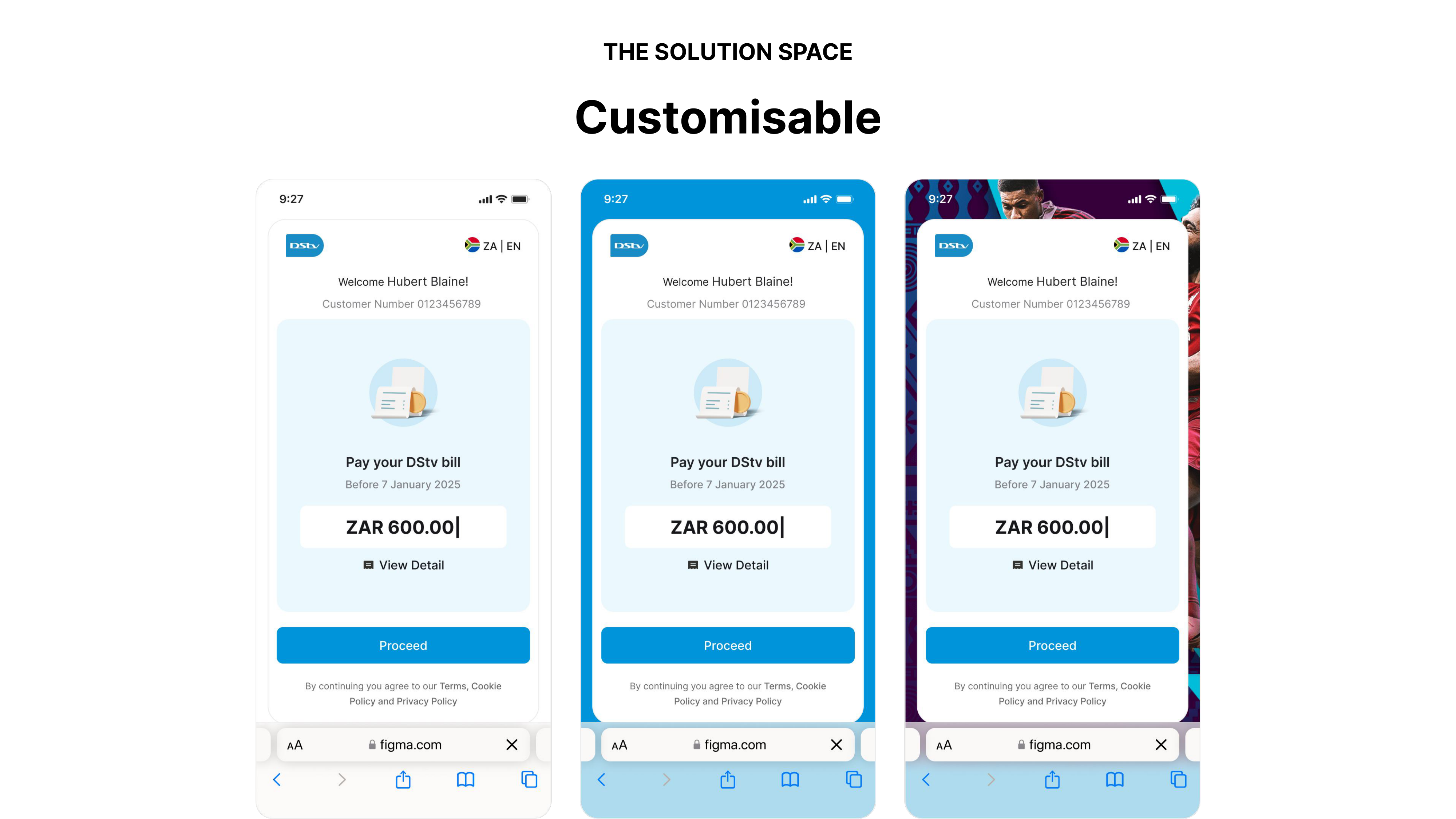
Customisable to each merchant's brand
One system, fully themeable per merchant.
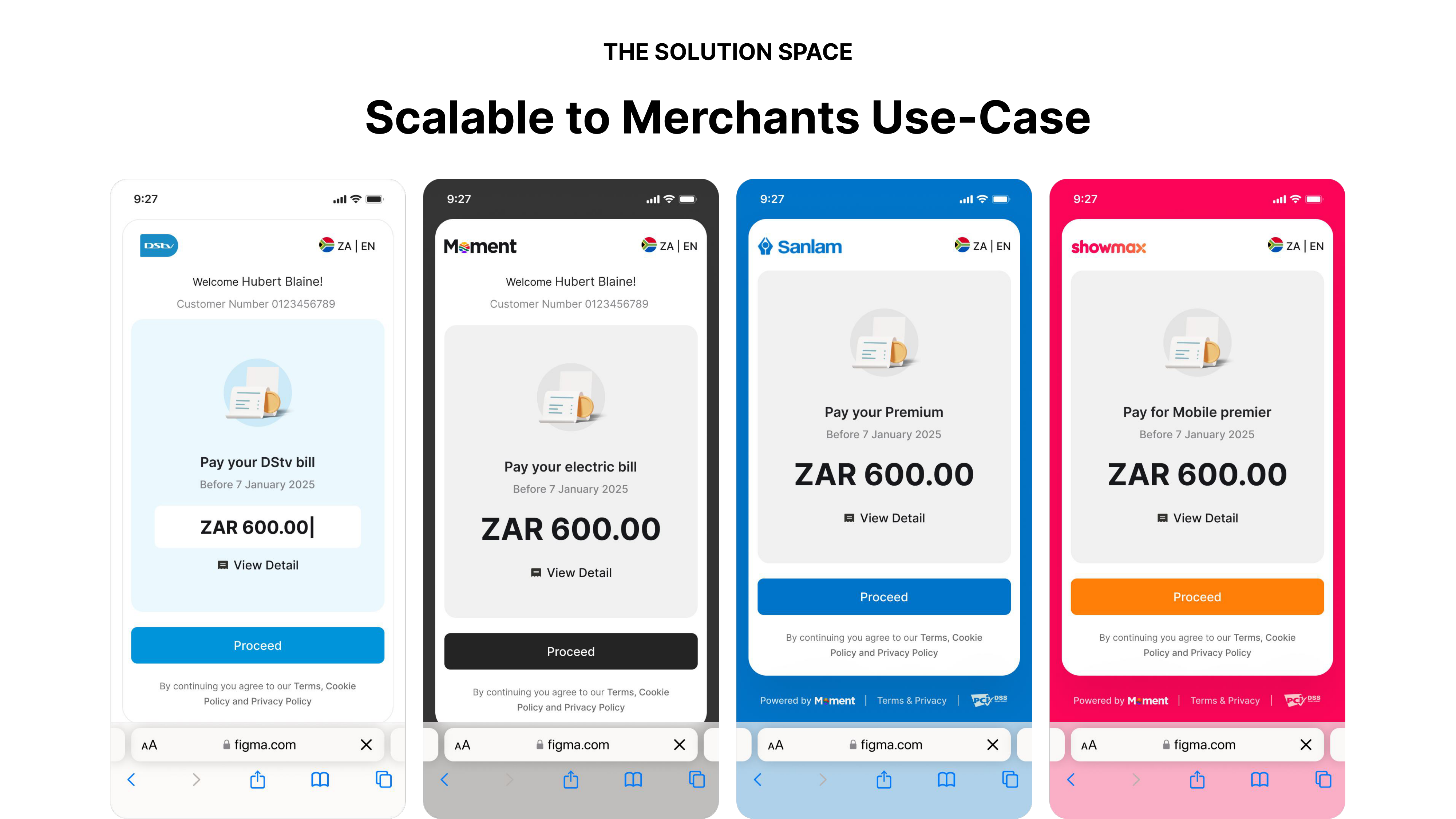
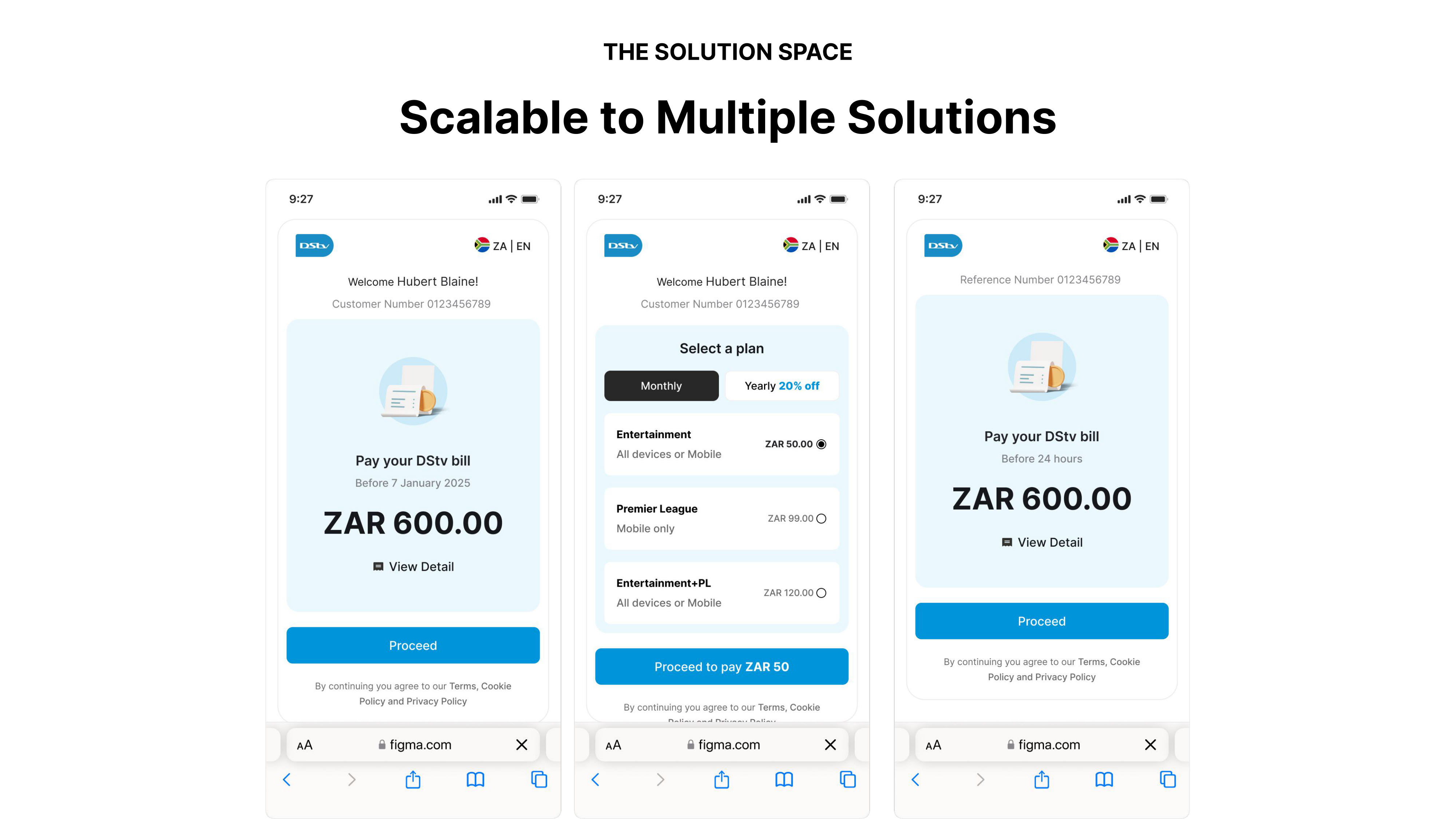
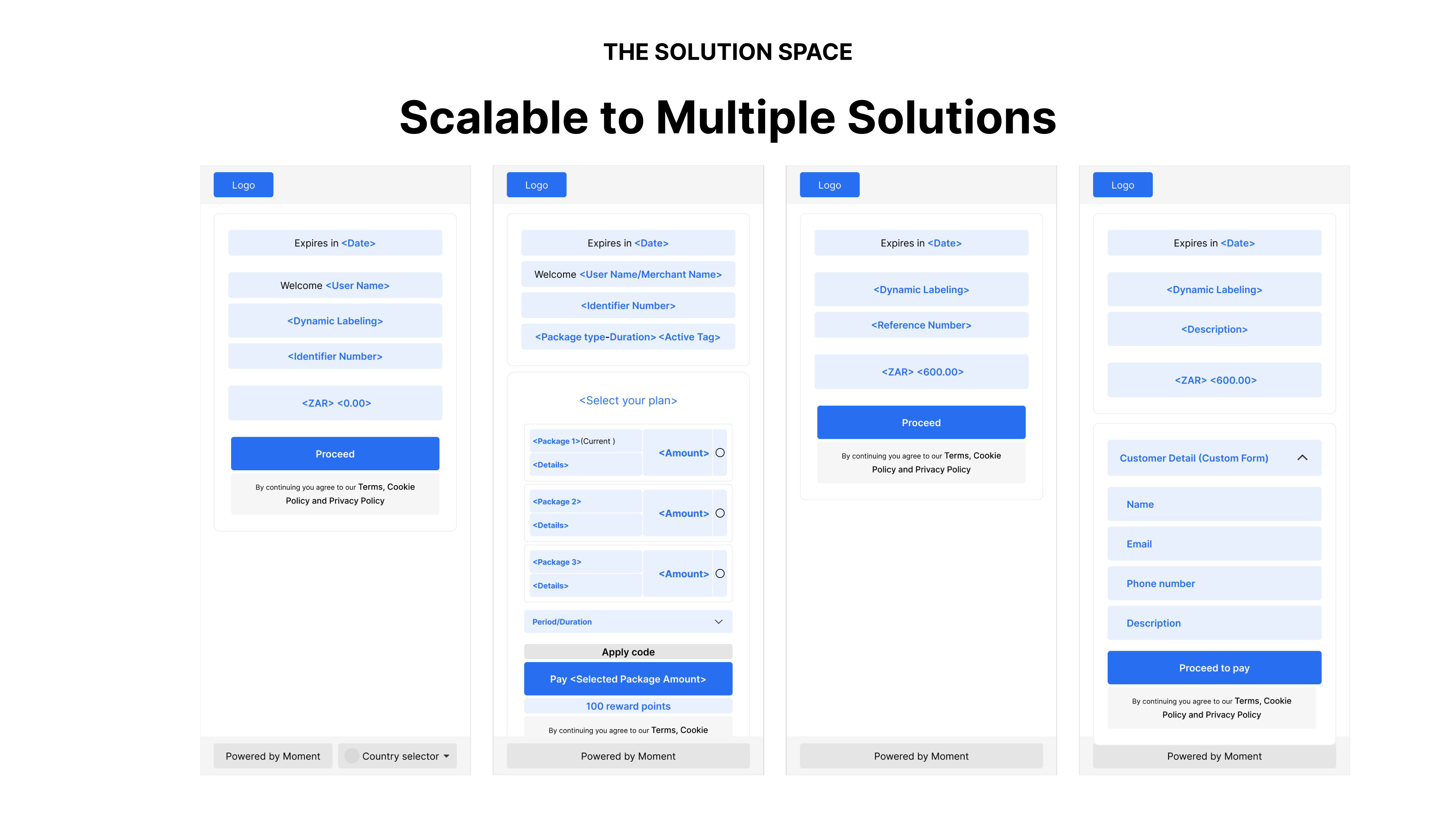
Scalable across merchants & solutions
Same flow across DStv, Moment, Sanlam, Showmax.Plan selection & subscription use-cases from the same parts.
Configurable templates: identifiers, plans, custom forms — no bespoke builds.
One checkout, every African market
Beyond a single set of methods, every African country gets its own localized list of
payment methods, ready to switch on. A merchant integrates one checkout and
instantly offers the rails their customers actually use — market by market. The result connects all
of Africa through a single integration, while the payment experience stays local and familiar for
every buyer.
No-code products for any team
To remove engineering as a dependency, I shaped no-code products on top of the same
system — a shareable Payment Link and a hosted Payment Page — so a
merchant with no developers can request and collect money in minutes.
Mobile & web SDKs for builders
For teams that do build, the same flow ships as mobile and web SDKs — drop-in
checkout that inherits every method, brand theme and local market, without re-implementing the
payment logic.
Cash payments for cash-based markets
Large parts of Africa still run on cash. To capture those buyers I introduced a
cash payment option — generating a reference the customer settles at an agent or
outlet — bringing offline, cash-first markets into the same unified, trackable flow.
08 / Impact
Impact
Unified Billing replaced manual recovery with a self-serve product that merchants can stand
up themselves and customers trust — built once, scaled across brands, methods, markets and the
whole of Africa.
$1B
TPV in 2 Years
Total payment volume within two years of launch
200K+
Users Across Africa
Merchants and customers transacting on the product
20→40%
Conversion Rate
Doubled across products after the unified flow
Conversion 20% → 40% — the unified flow doubled completion across products.
Faster checkout — cut the time taken to complete a transaction.
Higher transaction rate — cash payments via a token number pulled cash-first buyers into the flow, lifting completed transactions.
1 scalable billing system — replaced per-merchant custom builds.
Local methods in every African market — one checkout for cards, Capitec Pay, transfers, vouchers and cash.
No-code + SDKs — payment links, hosted pages and mobile/web SDKs for any team.
From chasing payments to a self-serve flow any merchant can run.